





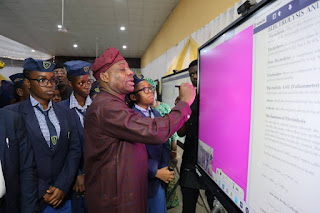
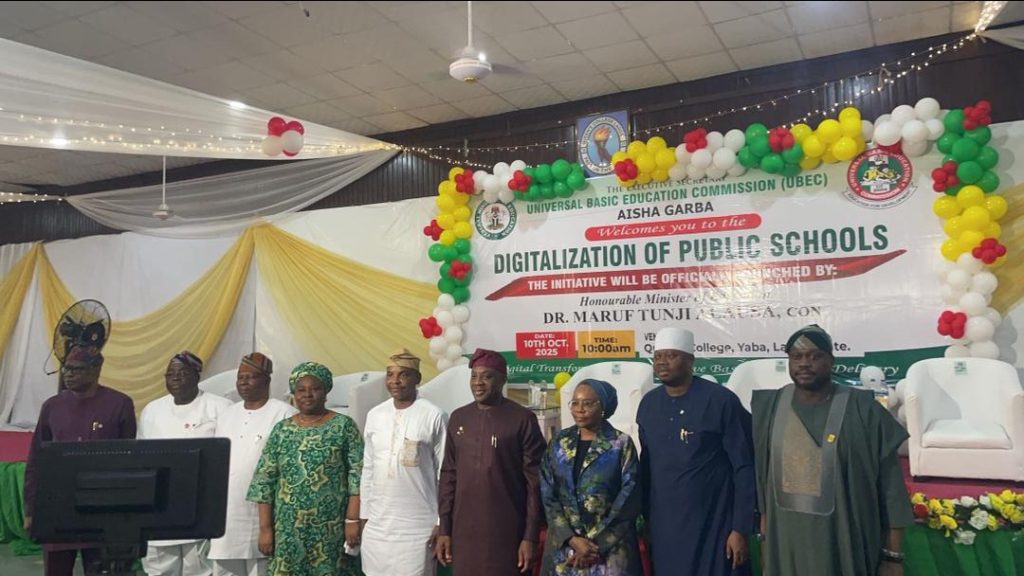
In a historic stride toward educational transformation, the Federal Government of Nigeria has officially launched the Digitalization of Public Schools Initiative, marking a bold leap into the future of learning. The landmark event, held at Queen’s College, Lagos on October 10, 2025, was spearheaded by the Honourable Minister of Education, Dr. Maruf Tunji Alausa, and attended by key stakeholders from across the education sector.
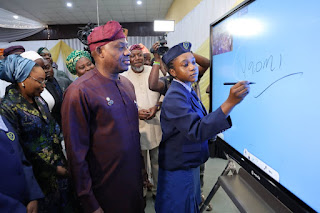
The initiative, which includes the nationwide distribution of Interactive Smart Boards, is a cornerstone of President Bola Ahmed Tinubu’s Renewed Hope Agenda, aimed at delivering accessible, technology-driven, and globally competitive education to every Nigerian child.
Dr. Alausa described the shift from chalkboards to smart boards as more than a technological upgrade—it’s a reimagining of the classroom experience. “We are not just connecting classrooms to the internet—we are connecting minds to opportunity,” he declared, emphasizing the importance of inclusive access to modern education tools.
The initiative is supported by complementary federal programs such as:- Nigeria Education Data Initiative (NEDI) for evidence-based planning – Nigeria Education Repository and Databank (NERD) for certificate authentication – $40 million Blueprint-ICT-Dev Project with AFD to enhance ICT infrastructure in universities
Through the Universal Basic Education Commission (UBEC), the Ministry is extending digital benefits to basic and secondary schools, ensuring broadband connectivity, teacher training, and digital tool distribution across all states.
UBEC’s Executive Secretary, Mrs. Aisha Garba, reaffirmed the Commission’s commitment to inclusive education, highlighting the transformative power of Interactive Smart Boards. “Lessons will become dynamic, visual, and participatory,” she said, noting ongoing efforts such as:- Distribution of 60,000+ tablets under BESDA-AF – Collaboration with NITDA on a Digital Literacy Curriculum – Establishment of Digital Learning Centres nationwide – Creation of a Department for Data and AI in Education.
In his welcome address, Dr. Hakeem Babatunde Shittu, Executive Chairman of the Lagos State Universal Basic Education Board (LASUBEB), delivered a stirring message:“It is with immense joy and a profound sense of purpose that I welcome you all to this epoch-making event—the formal launch of the full-scale Digitisation of our Public Primary and Junior Secondary Schools in Lagos State. Today is not just another milestone; it is a watershed moment, a vivid demonstration that the future we speak of is not distant, but a reality we collectively built. This comprehensive digital initiative is a core component of President Bola Ahmed Tinubu’s Renewed Hope Initiative, in alignment with Governor Sanwo-Olu’s transformative THEMES Plus Agenda, specifically under the crucial pillar of Education and Technology. At LASUBEB, we have keyed fully into this transformative vision. Our flagship programme, EKOEXCEL, is a testament to the State Government’s resolve to digitise classroom learning and empower teachers with technology for improved lesson delivery. The success of this initiative has positioned Lagos as a national reference point for technology integration in education and has created a solid foundation upon which today’s UBEC digitisation project can thrive. Together, we will continue to strengthen the education ecosystem and make learning in Lagos public schools smarter, interactive, and more impactful.
IGBEGA IPINLE EKO, AJU MO SENI.”
For students like 14-year-old Amina at Queen’s College, the initiative is life-changing. “I’ve always wanted to learn coding and robotics,” she said. “Now, it’s possible right here in my school.”
As the sun set over Yaba, the launch symbolized more than policy—it ignited a movement. With smart boards lighting up classrooms and digital tools empowering teachers, Nigeria’s education system is stepping boldly into a new era—one of innovation, inclusion, and global relevance.
