






A solidarity protest was held at the Lagos State House of Assembly by the Nigeria Coalition Group and Yoruba Council Worldwide, demanding protection for Dangote Refinery and full support for President Tinubu’s Renewed Hope Agenda.
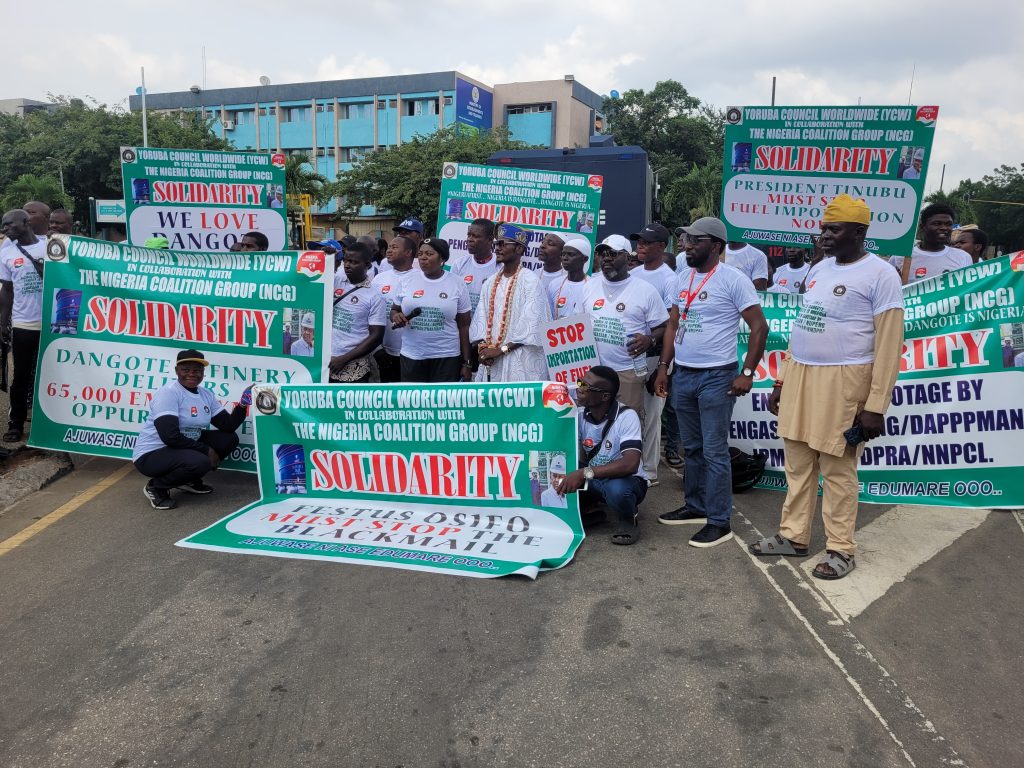
Here’s a detailed breakdown of the protest and its demands:

Key Demands from the Protest
•Immediate implementation of a 15% import duty tariff on refined petroleum products.
•Total ban on the importation of Premium Motor Spirit (PMS) and Automotive Gas Oil (AGO) to protect domestic refining, especially the Dangote Refinery.
•100% crude oil allocation for Dangote Refinery, ensuring uninterrupted access to feedstock for full operational capacity.
Statements from Leadership
•Aare Oladotun Hassan, President of the Yoruba Council Worldwide and leader of the Nigeria Coalition Group, accused oil cabals and union leaders of sabotaging Dangote Refinery.
•He condemned PENGASSAN, led by Comrade Festus Osifo, for allegedly orchestrating shutdowns and spreading false narratives against the refinery.
Political Engagement
•The protest was staged at the Lagos State House of Assembly, where the group was received by Hon. Noheen Adam, representing Ibeju Lekki, and the Clerk of the House.
•They promised to relay the group’s message to Speaker Rt. Hon. Mudasiru Ajayi Obasa, with a commitment to follow up.
Industry Tensions
•The group expressed concern over DAPPMAN’s lobbying efforts to extend fuel import licenses until the end of Q1 2026, which they view as a threat to Nigeria’s energy independence.
•They called for an end to fuel import dependency, aligning with President Tinubu’s Renewed Hope Agenda and “Nigeria First” policy.
Broader Coalition Support
•The protest was backed by multiple groups including:
•Nigeria Youth Coalition (NYC)
•Coalition of Southern Groups (CSG)
•National Youth Stakeholders Forum (NYSF)
•These groups emphasized the economic losses—estimated at over ₦30 billion—due to sabotage and delays in refinery operations.
This protest reflects growing civil society pressure to prioritize local refining and reduce reliance on imported fuel. If implemented, these demands could reshape Nigeria’s petroleum landscape and bolster the Dangote Refinery’s role in national energy security.
